
DOI: https://doi.org/10.25259/DAF_BTC_v1i1a1_2026 Gazetteer published in 1880 offers a revealing description
of a temple in the Gujarati town of Mandvi: “The Haveli of Ranchhodji
Maháráj, a Vaishnav temple of the Vallabháchárya sect, is a two storied
tiled house built round an open court like the dwellings of Mándvi
traders. It is much resorted to by Bhátiás who go there to worship
several times a day”.1 This account neatly captures two key
points: first, it defines the havelī as an aristocratic mansion
organized around a central courtyard. This type of residence is
traditionally associated with wealthy patrons, in this case the Bhatia
community of merchants. Second, it shows that the term havelī
is not confined to residential dwellings, but it also applies to the
temples of the Vallabha Sampradāya, a Vaiṣṇava devotional sect founded
by the saint-philosopher Vallabhācārya (1479–1531).2 The Vallabha Sampradāya employs a distinctive set of terms to define
its sectarian tradition. These function as markers of identity,
distinguishing its adherents and ritual practices from other religious
communities. One of their most important terms is sevā which
refers to the selfless ritual service offered to an icon of Krishna.
This designation is used instead of pūjā, the more common word
for worship. Sevā is directed toward sacred images of Krishna
that the sect calls svarūps, or self-manifested icons,
distinguishing them from mūrtis, the sacred images of other
religious traditions. Svarūps are revered as actual
manifestations of Krishna and are cared for as living beings endowed
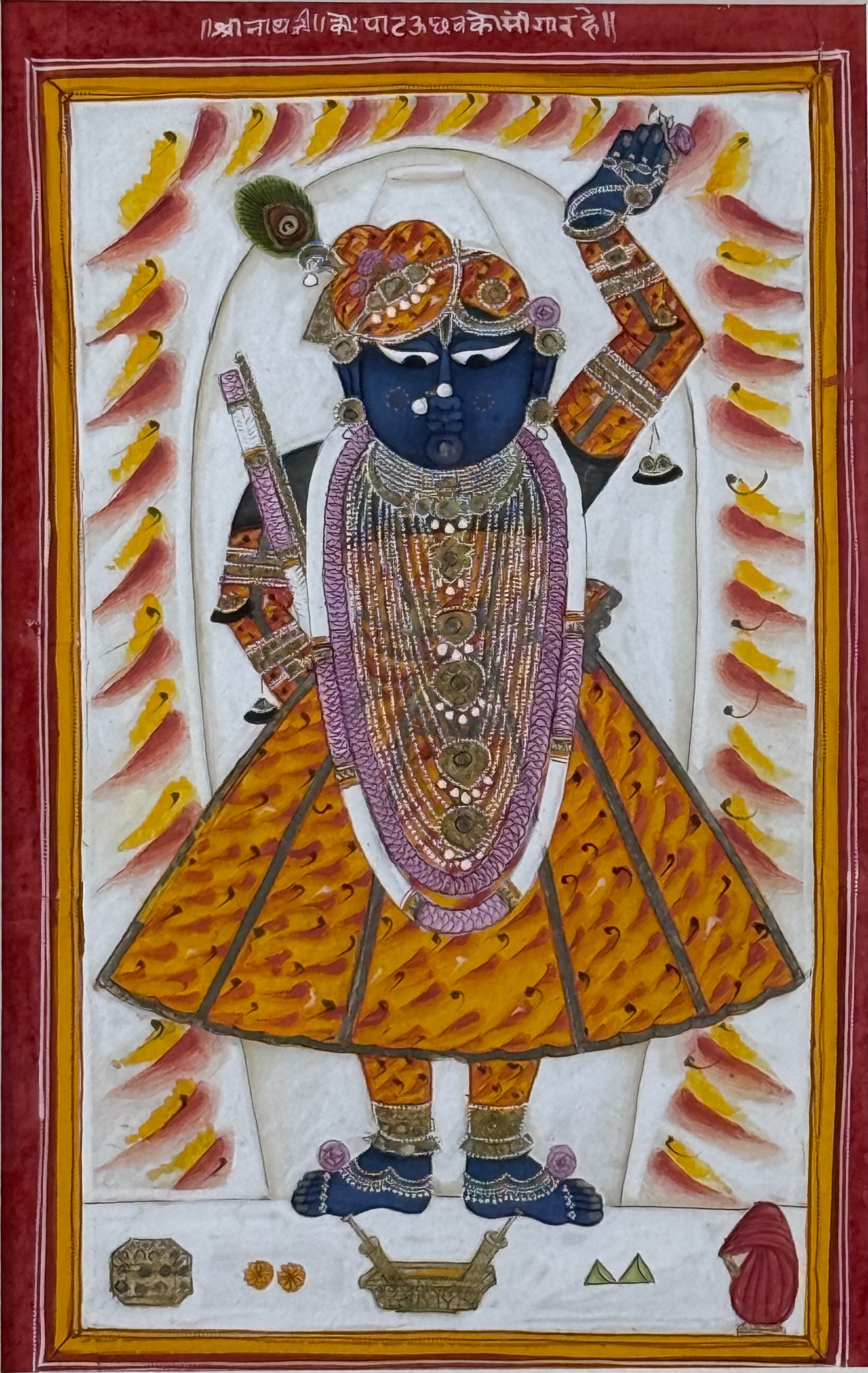
with agency. The sect’s most important svarūp is Śrī Nāthjī, a
black marble sculpture housed in a temple in Nathdwara, Rajasthan
(Figure 1). Another distinctive term is havelī,
used to designate the sacred spaces of the Vallabha Sampradāya. Its most
prominent example is the havelī of Nathdwara, established in
1672 after Śrī Nāthjī was transferred from its original shrine on
Govardhan Hill in Braj. Its relocation was prompted by the
destabilization of the Braj region resulting from the Jat rebellion of
1669 against the Mughals. Within the study of Indian temple architecture, the expression
havelī (henceforth havelī-temple to distinguish it
from residential dwellings) remains elusive. It gained significance in
the late nineteenth century within the broader context of Vallabhite
sectarian identity formation and institutional consolidation. Despite
its relatively recent emergence, the term is often assumed to have been
in use in earlier periods. Given its conceptual ambiguity, the present
paper focuses on the term as employed within the Vallabha Sampradāya
with the aim of clarifying its definitions. Before turning to this
topic, it is necessary to introduce two terms originally used by the
sect to designate its places of worship: ghar (house) and
mandir (temple). The discussion then turns to the prevailing
interpretations of the havelī-temple, which are examined
through geographic, devotional and legal perspectives. The analysis
ultimately suggests that the havelī-temple is better understood
as an architectural archetype. Namely, it is not a clearly defined
temple typology within the Indian architectural tradition, such as the
śāstric Nāgara and Drāviḍa types. Its defining features are the
presence and the ritual access to a sectarian icon or svarūp.
Although a courtyard is often regarded as an essential feature, it is
not in fact indispensable. Understanding the havelī-temple requires first examining two
other terms traditionally used for the built spaces of the Vallabha
Sampradāya: ghar (house) and mandir (temple). Rather
than denoting distinct architectural typologies, these terms indicate
whether the sectarian svarūp they house is publicly accessible
or restricted. In this sense, ghar and mandir depart
from conventional architectural classifications of the Hindu temple, as
their distinction rests not on formal or spatial characteristics but on
patterns of ritual access. The two terms coexist and remain in use
today, reflecting differing degrees of privacy, accessibility and public
engagement. Originally, devotional practice was understood as private and
household-centered, rather than as a publicly accessible form of worship
typical of a mandir. In this early context, worship was marked
by simplicity and intimacy, qualities that stand in marked contrast to
the formalized ritual performances of the present day. Consistent with
the emphasis on household practice, most Vallabhite icons are small,
suggesting that they were intended not for public installation in
temples but rather for personal or domestic worship. As explained by
Mumbai-based scholar and sectarian leader Shyam Manohar Goswami, the
term ghar derives from the early stages of sectarian worship,
when sevā was conducted within private residences. He further
notes that this domestic framework contrasts with later developments in
which certain deities—most notably Śrī Nāthjī—became associated with
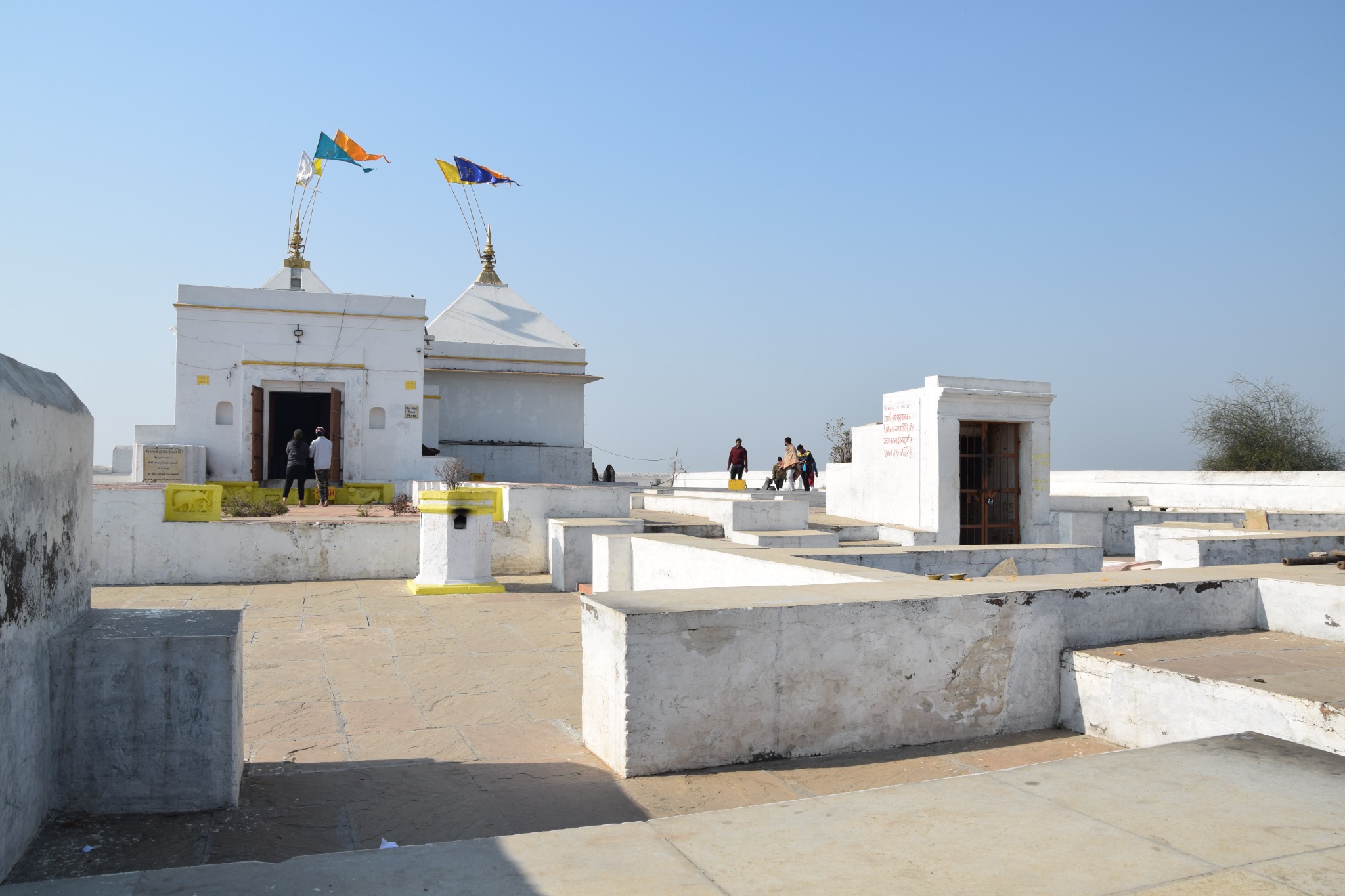
public accessibility.3 Indeed, it is usually accepted that
the icon of Śrī Nāthjī, installed in its temple on Govardhan Hill
(Figure 2), was accessible to pilgrims and devotees,
whereas other sectarian icons may not have been publicly available for
worship. The restricted access to the icons is said to have become more
pronounced following the death of Vallabhācārya’s son, Viṭṭhalnāth
(1515–1585), when the worship of sectarian deities is believed to have
been entrusted exclusively to his seven sons and their descendants.4 Although the distinction between public and private icons can be
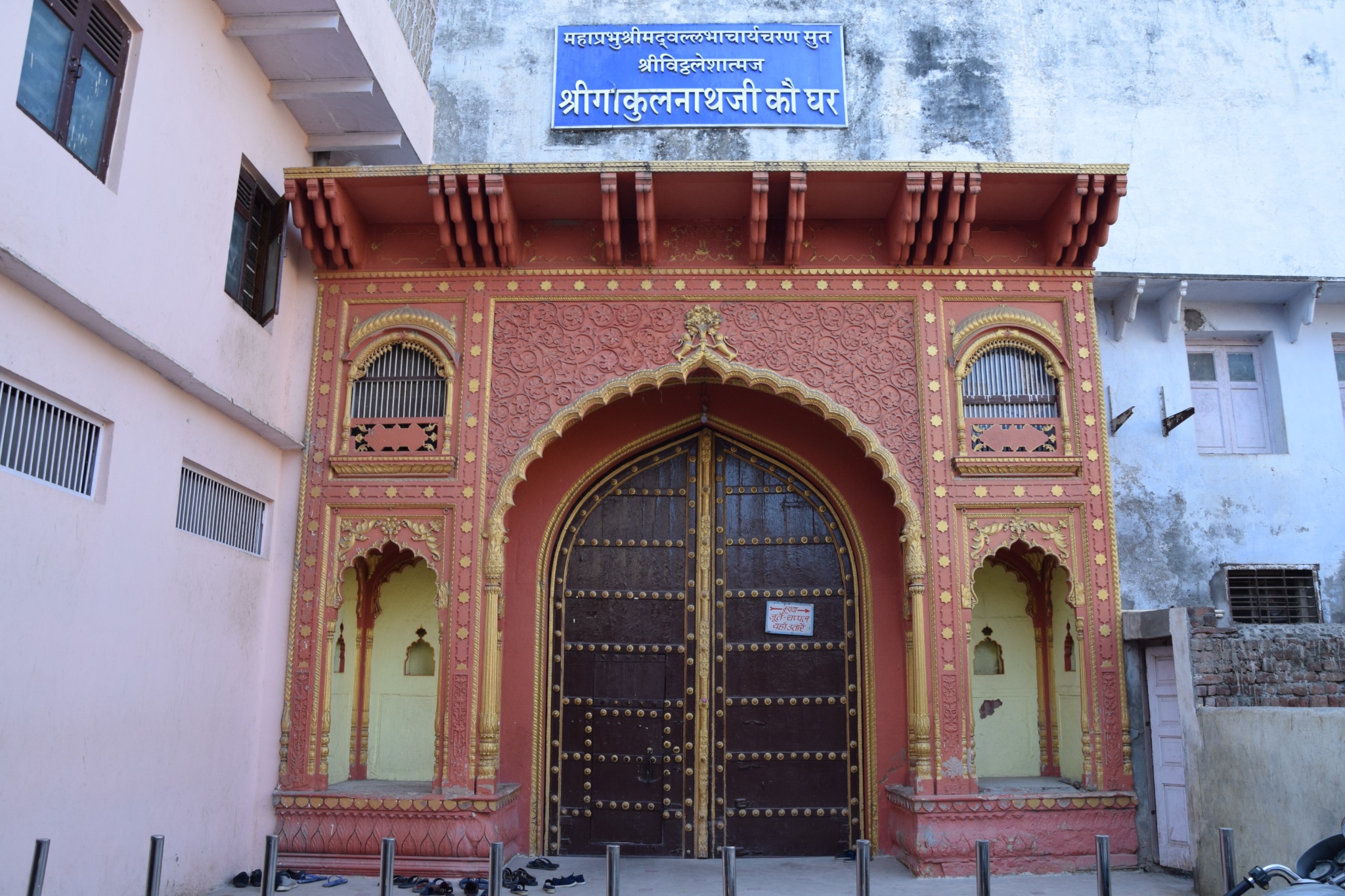
inconsistent, a key example clarifying the notion of access is provided
by the svarūp of Gokulnathji, a four-armed form of Krishna
associated with the village of Gokul in Uttar Pradesh. The deity is
attended by descendants of Vallabhācārya and Viṭṭhalnāth and it resides
in a private mansion, which is also designated today by the term
ghar (Figure 3). The residence is closed to the
public, while access to the icon is permitted only on specific ritual
occasions, when the image is ceremonially brought to Jatipura, Uttar
Pradesh. One such occasion is the Annakuta festival, celebrated on the
day following Diwali. Rather than remaining in its private ghar
in Gokul, the svarūp is transferred to a temple at the foot of
Govardhan Hill in Jatipura, where it is made accessible to devotees and
pilgrims.5 The other term that identifies the sacred spaces of the Vallabha
Sampradāya is mandir, the customary Hindi word that stands for
a Hindu temple. This was used to designate the original Śrī Nāthjī
temple on Govardhan Hill, which was allegedly destroyed in the wake of
the 1669 Jat rebellion against the Mughal forces and later rebuilt as a
simple modern shrine (Figure 2). It is possible that the
original temple followed the traditional Nāgara typology, as suggested
by some of its surviving remains, including its threshold marked by a
moonstone, and by descriptions in sectarian literature, which mention
the presence of a śikhara superstructure.6
Sectarian literature suggests that the temple was referred to as a
mandir, not a havelī, and conceived as a space
accessible to devotees beyond the close descendants of Vallabhācārya and
Viṭṭhalnāth. A special mention appears in a travelogue by a devotee from
Bikaner, who visited the temple during his pilgrimage in Braj in 1656.7 Amid the disruptions of the 1669 Jat rebellion in Braj, Śrī Nāthjī
was removed from the temple on Govardhan Hill and transferred to a safe
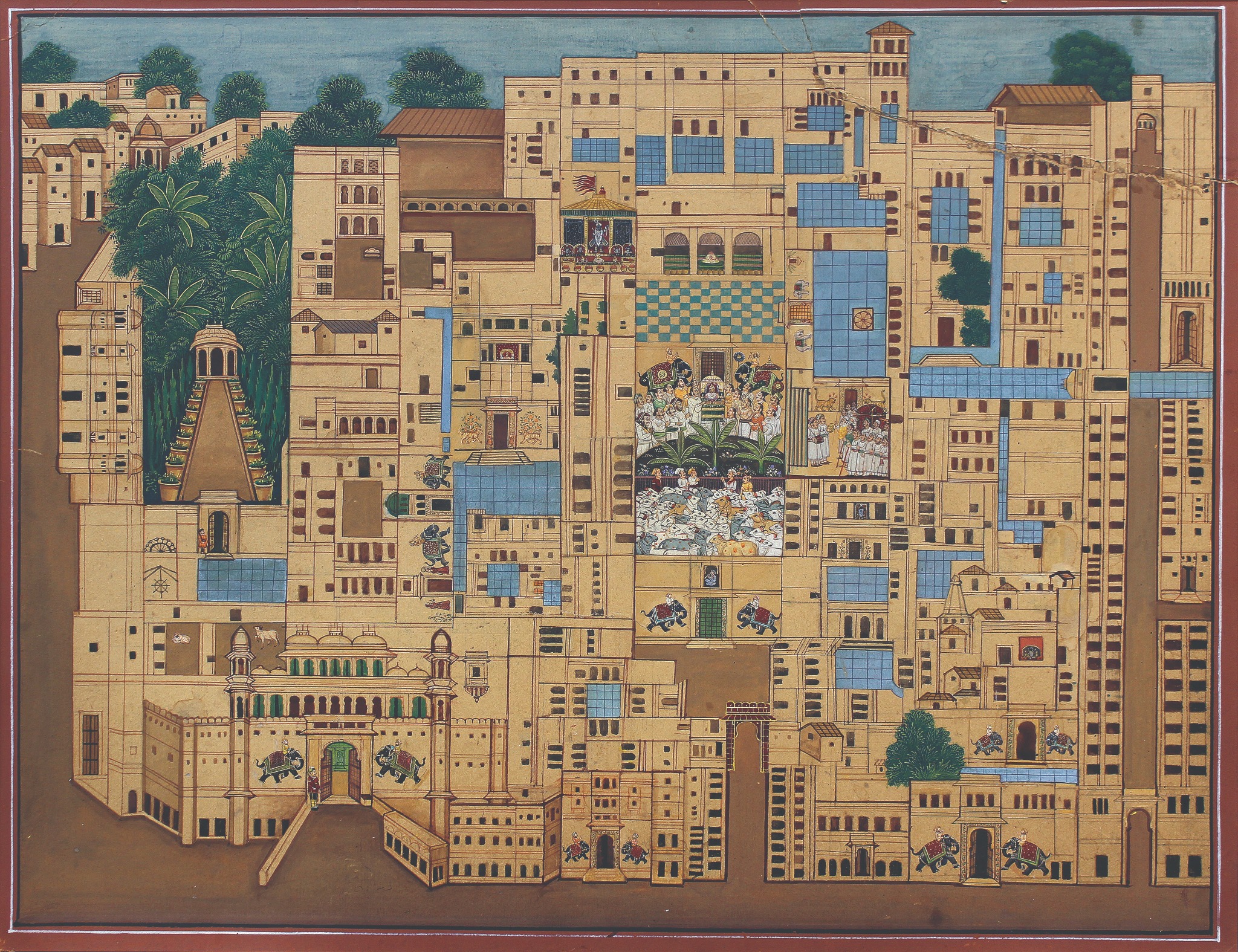
site. After a long journey, in 1672 the icon was installed at Nathdwara,
in the Kingdom of Mewar in Rajasthan, where it continues to reside. Like
its earlier temple on Govardhan, the establishment at Nathdwara
indicated patterns of public use and accessibility, as is evident from
its architectural configuration: the complex comprised a cluster of
structures, including shrines, ritual spaces, and courtyards.8 This arrangement suggests a setting
that was open to devotees, as it remains today (Figure 4).
While today this complex is commonly referred to as a havelī,
sectarian sources identified it as a mandir.9
Likewise, Frederic Salmon Growse (1837–1893), District Magistrate of
Mathura from 1871 to 1877, never used the term havelī in his
memoirs, which contain descriptions of Vallabhite temples in Jatipura
and Gokul.10 Although the designation
havelī does not appear in the extant literary and inscriptional
evidence, it subsequently gained prominence and entered common
parlance. Although the expression havelī-temple is used today, its
widespread adoption is relatively recent. The circumstances behind its
emergence, however, remain unclear. While no single definitive answer
exists, its diffusion may be approached from geographic, devotional, and
legal perspectives. Notably, these frameworks are not architectural, let
alone śāstric; instead, they rest primarily on empirical
evidence. For this analysis, it is necessary to begin with residential
havelīs, typically defined as courtyard houses or mansions.
Some scholarly accounts conceptualize them as a form of dwelling
characterized by two principal features: a central courtyard and the
elevated social status of the patron.11
An early usage of this term to indicate a Vallabhite temple is found in
the 1880 Gazetteer mentioned in the introduction which refers
to the “Haveli of Ranchhodji” in Mandvi, Gujarat. Indeed, Gujarat as
well as Rajasthan are historically associated with a strong presence of
the Vallabha Sampradāya and its prominent svarūps. From a
geographic perspective, thus, the spread of the term
havelī-temple may be linked to the diffusion of residential
havelīs across both vernacular and elite contexts in Gujarat
and Rajasthan. The spatial proximity between the sect and the
residential havelīs of wealthy merchants—many of whom were
followers—likely facilitated the extension of the term from the domestic
to the devotional domain. Since the term havelī, in its residential sense, also
implies the high social status of the owner, some scholars have
suggested that an explanation for the havelī-temple may lie in
the distinctive treatment accorded by the sect to its sacred icons.12 Vallabhite svarūps are
understood as incarnations of Krishna and are treated as living beings
endowed with agency. They are awakened each morning, bathed and adorned,
offered meals throughout the day, and ceremonially put to rest each
night. In this sense, they can be conceptualized as noble figures
(thākur-jī) residing in their own mansions.13
Thus, the term havelī came to be used for the temples
associated with the svarūps, whose status is understood as
analogous to that of a noble inhabiting a mansion.14 Beyond the definitions outlined above, the use of the term
havelī-temple can also be explained in more pragmatic terms,
particularly within legal frameworks. This designation gained wider
prominence and circulation in the late nineteenth century in the context
of legal disputes concerning the ownership and control of Vallabhite
temples. These included issues related to sectarian icons, endowments,
and associated properties.15 In Nathdwara, the
Mewar rule and subsequently the Government of India increased their
intrusion in the affair and wealth of the temple and made the point that
all the properties of the sect’s leaders were public and not private. As
a response, the sect’s leaders claimed that their temples were instead
private mansions, a framing in which the term havelī was
employed: they argued that worship of their deities was essentially
domestic in nature and that access for devotees required prior
permission. Thus, in their interpretation, the havelī-temple
was defined as a synthesis of the earlier concepts of ghar and
mandir, somewhere in between the private and the public.
However, these assertions were consistently contested in judicial
proceedings, where courts repeatedly held that the temples, their
deities, and associated movable and immovable properties were public. In
this legal interpretation, sect leaders were consequently redefined not
as owners but as custodians, trustees, or managers of temple assets. In this legal context, sectarian leaders deployed the term
havelī-temple as a strategic synthesis of the older categories
of mandir and ghar, presenting the Nathdwara complex
as a private residence while maintaining that devotees could access the
svarūp through prior authorization, thereby allowing forms of
public access at designated times. This rhetorical shift reflects
attempts to influence the legal interpretation of temple ownership, in
which the term havelī-temple came to occupy an intermediate
position between ghar and mandir. However, the
assertion of the temple’s private character became increasingly
difficult to reconcile with the lived realities of worship, which
evolved into a more public and ceremonially structured practice, marked
by elaborate displays of wealth and the presence of large congregations
of devotees. Scholars of the Hindu temple have long relied on treatises that
classify architectural forms according to regional typologies based on
both structural and non-structural components.16
These texts establish a normative framework through which architectural
variation can be interpreted in terms of recognizable types, such as the
Nāgara and the Drāviḍa temples. However, during the early modern period,
with the emergence of Hindu temples associated with Vaiṣṇava devotional
sects in northern India, these classificatory models became inadequate.
Many such sacred structures do not conform to established paradigms or
diverge from them significantly. The devotional spaces of the Vallabha
Sampradāya—whether havelī-temple, ghar, or
mandir—do not follow any established category within the
traditional taxonomy of Hindu temple architecture. Rather than being
defined by specific architectural forms, ground plans, or stylistic
features, they are characterized by varying degrees of access to the
svarūp, reflecting different levels of privacy and public
engagement. The term havelī-temple has also been applied beyond the
Vallabha Sampradāya tradition, further contributing to its
terminological ambiguity. In Jaipur, for example, havelī is
used to describe both sectarian and non-sectarian temples in the old
city. A prominent example includes the Govind Devji, a complex
associated with Gaudiya Vaishnavism built in 1735.17
The temple, rather than following the spatial logic of a traditional
mansion with a central courtyard, was conceived as a bārādarī
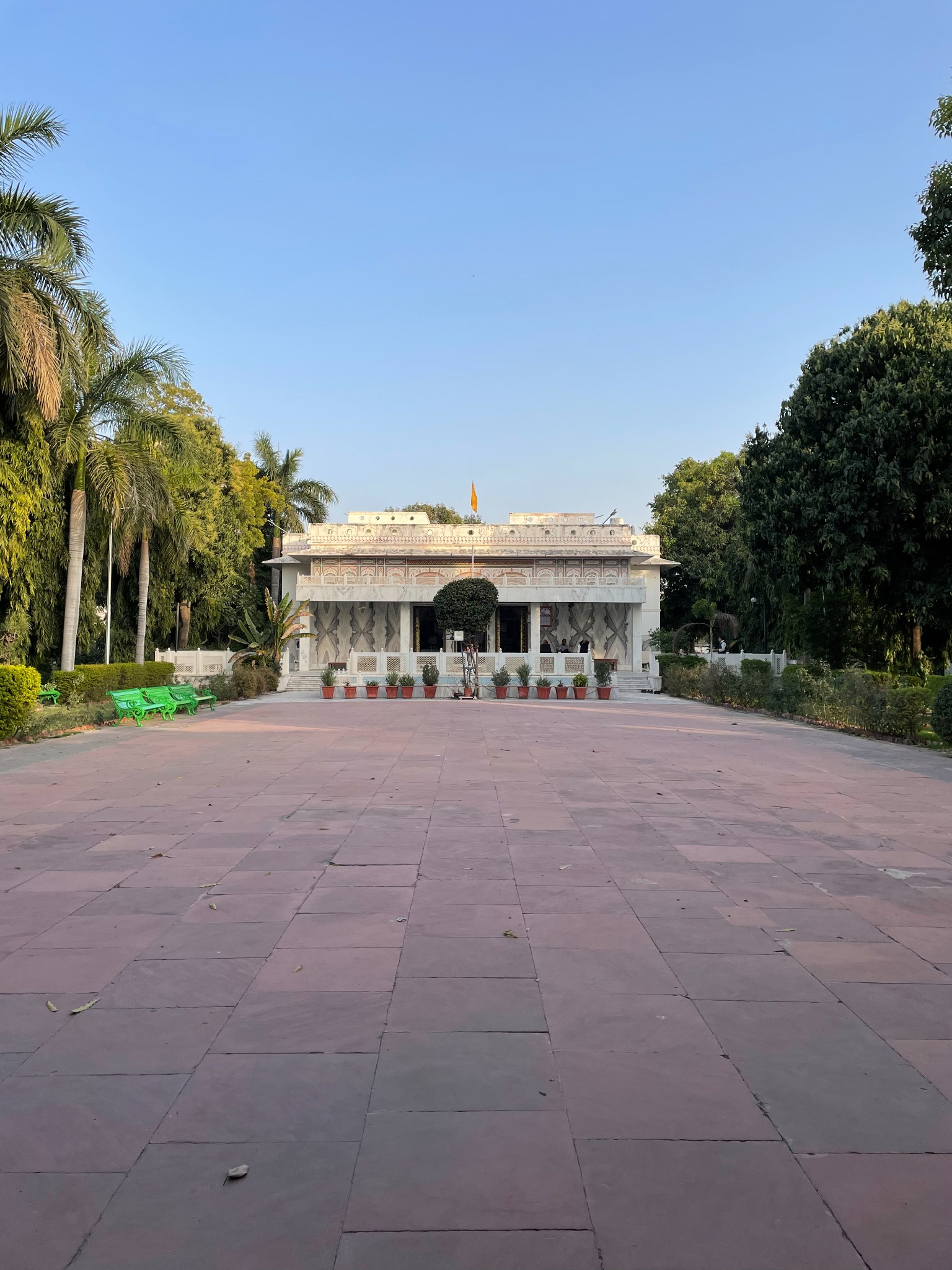
(hypostyle hall) set between two formal gardens. A similar arrangement
is found at the Sethani-ji ka Bagh, a modern Vallabhite temple in
Jaipur, which likewise lacks the customary courtyard, with the main
building situated within a formal garden (Figure 5). This
further complicates the attempt to find a fixed architectural
definition, rendering the category havelī-temple fluid and
difficult to delimit, as it encompasses a range of building types and
spatial configurations. Thus, to conclude, the havelī-temple is better understood as
a conceptual category rather than as a fixed architectural type. Its
definition does not rest on formal or stylistic characteristics, but
rather on the presence and ritual access to a svarūp.
Particular emphasis is placed on spaces dedicated to sevā,
which may occupy a courtyard. While courtyards are frequently present,
owing to regional architectural traditions and climatic conditions, a
temple like the Sethani-ji ka Bagh demonstrates that they cannot be
regarded as defining features. Thus, rather than a formal architectural
typology, the havelī-temple operates as a flexible archetype
shaped by many variables. This essay is based on a research project funded by the Luigi and
Laura Dallapiccola Foundation. I am grateful to Shyam Manohar Goswami
and Shandip Saha for their valuable discussions on aspects of this
research at different stages of its development. I would also like to thank Vikram Dogra for inviting me to contribute to the inaugural volume of this publication.
Bridging the ContinentsA Quarterly Publication of the Dogra Art Foundation
A Flexible Archetype — Isabella Nardi
transcending all differences.
ISSN 3070-8648Table of Contents
A Flexible ArchetypeThe Havelī-Temple in the Vallabha Sampradāya Tradition
Ghar and Mandir: Domestic and Sacred Spaces
in the Vallabha Sampradāya Tradition
Conceptual Definitions of Havelī-Temple
The Havelī-Temple as an Archetype
Acknowledgement
Dogra Art Foundation
Inside this issue
Connecting People through Art,
Bridging the ContinentsDogra Art Foundation Quarterly
Volume 1 · Issue 1 · 2026
Art · Scholarship · Heritage · Community
Scholarly EssaysA Flexible ArchetypeIsabella Nardi
Scholarly Essays · Architecture and sacred space